
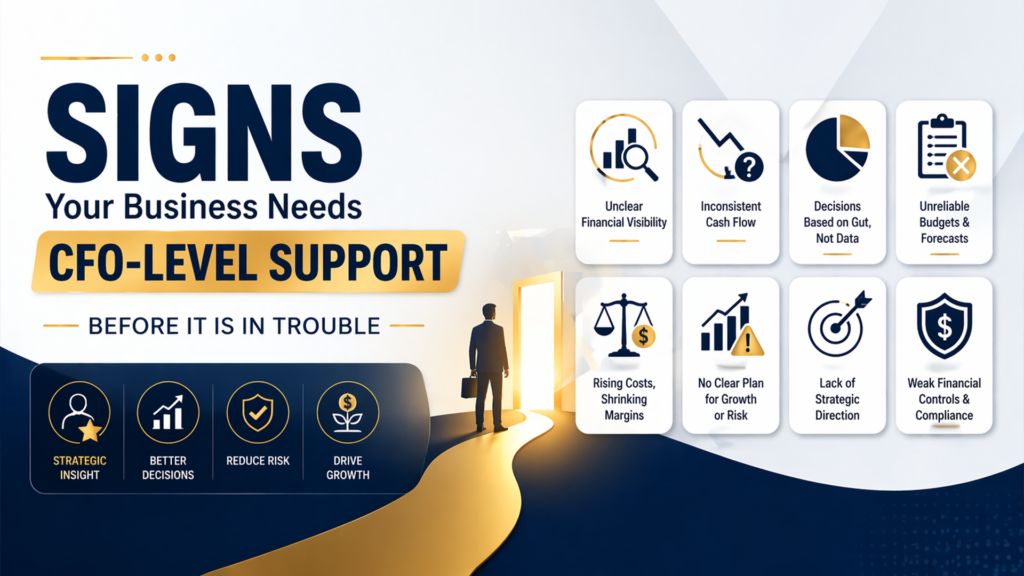
Most business owners do not wake up one morning and say, “It is time to bring in CFO-level support.”
What usually happens is quieter.
The business gets busier. Revenue moves around. Payroll gets heavier. Vendor payments stack up faster. Pricing decisions become harder to make with confidence. The owner starts asking the same question in different ways: Are we actually doing well, or are we just moving fast?
That is the point where a business often needs more than bookkeeping, tax filing, or a once-a-month set of reports.
It needs financial leadership.
Not necessarily a full-time CFO sitting in the office every day. But it does need someone who can help the owner see what the numbers are saying before those numbers turn into pressure, bad decisions, or expensive surprises.
The SBA’s own guidance for small businesses emphasizes using core financial statements to manage the business, not just to satisfy paperwork. Income statements, balance sheets, and cash flow statements are decision tools. They are supposed to help owners understand performance, financial position, and where money is actually moving.
A lot of businesses have those statements.
Far fewer are using them well.
You Are Closing the Books, But Still Flying Blind
This is one of the clearest warning signs.
The month ends. Reports get produced. Numbers exist. But no one is translating them into practical decisions. The owner can see sales, expenses, and maybe net income, but still cannot answer the bigger questions with confidence.
Are margins improving or quietly shrinking?
Is the current hiring pace sustainable?
Can the business handle a slow quarter without stress?
Is this the right time to expand, borrow, or raise compensation?
When financial reporting stops at “here is what happened,” the business is missing the part that matters most. A CFO-level advisor helps connect past results to future choices. Without that layer, the owner is left with information but not direction.
That gap is where trouble usually begins.
Cash Is Always Tighter Than It Should Be
This problem shows up in good businesses all the time.
Sales may be decent. The team may be working hard. Customers may be coming in. On paper, the business may even look profitable. Yet cash still feels tense. The owner keeps checking the bank balance, moving money around, delaying a purchase, or hoping a few receivables come in before the next round of obligations hits.
That is not just a bookkeeping issue.
That is a financial management issue.
The SBA continues to stress cash flow as a separate discipline because profitability and cash are not the same thing. A business can look healthy on paper and still feel constant pressure if timing, collections, debt, payroll, inventory, or owner distributions are working against it.
Owners often think this kind of pressure means they need to sell more.
Sometimes they do.
Sometimes the real problem is that no one has built a reliable cash model around how the business actually operates.
You Are Making Major Decisions on Instinct
Instinct matters in business. Experience matters too.
But when a company starts making bigger financial decisions, instinct alone stops being enough.
That is especially true when the business is deciding whether to hire, increase wages, open another location, add debt, change pricing, invest in equipment, or prepare for a sale. Those are not small moves. They should not be based on a rough feeling that “things seem okay.”
The SBA’s finance guidance points business owners back to the three core financial statements for a reason. Each one shows a different part of the business. The income statement shows performance. The balance sheet shows financial position. The cash flow statement shows how money actually moves in and out. Looking at one without the others is how owners talk themselves into decisions the numbers do not fully support.
If major choices are being made from partial information, the business may already be overdue for stronger financial oversight.
Your Margins Are Slipping and Nobody Can Explain Why
This is where many owners start feeling that something is off.
The business is busy. The calendar is full. Sales are moving. But the money left over does not feel right. The owner senses that more effort is producing less breathing room.
That usually does not come from one dramatic mistake.
It comes from a pile of smaller ones.
Labor creeps up without enough pricing adjustment. Product mix changes. Discounts become too easy to offer. Vendor costs rise slowly enough that no one reacts. A service line that looks healthy at the top line turns out to be weak at the margin. The business keeps operating, but the economics underneath it are getting worse.
This is where CFO-level support becomes practical, not fancy.
Someone has to break the business down and ask better questions. Which services are actually driving profit? Which locations, channels, or customer types are underperforming? Which expenses are now structurally too high? Which decisions made sense six months ago but no longer fit the numbers?
Without that kind of review, margin erosion can keep going for far too long.
Tax Season Keeps Exposing the Same Mess
A healthy finance function should not fall apart every time tax season arrives.
If your accountant or tax preparer keeps discovering cleanup issues, missing records, misclassified expenses, payroll inconsistencies, or owner transactions mixed into the books, that is not just a tax-prep inconvenience. It is a sign the business does not have enough financial control during the year.
The IRS is direct about recordkeeping. Businesses need books and records that clearly show income and expenses, and business transactions should be recorded in a usable system rather than reconstructed later from scattered documents.
When tax preparation turns into a yearly rescue job, it usually means the business needs more than compliance help. It needs structure, review, and someone paying attention before year-end.
Growth Is Creating Confusion Instead of Confidence
Growth sounds like success because it often is.
But growth also exposes weak financial systems faster than anything else.
A business that was manageable at one size can become financially messy at the next. More staff means more payroll pressure. More revenue means more receivables and more timing issues. More vendors, locations, or service lines make the numbers harder to interpret. The owner loses visibility at the exact moment the business needs better visibility.
That is when many founders and operators hit a frustrating middle ground.
They are too big to run everything by feel.
Too complex to rely only on basic bookkeeping.
Still not ready, or not interested, in hiring a full-time CFO.
That middle ground is where outsourced or part-time CFO support often makes sense. Not because the business is failing, but because the business has outgrown simple financial management.
You Are Watching the Bank Balance More Than the Business
The bank balance can tell you whether cash is available right now.
It cannot tell you whether the business is improving.
It cannot tell you whether margins are healthy, whether collections are slowing, whether pricing is keeping up with cost pressure, or whether the company is one weak quarter away from a problem.
Owners who run the business from the bank balance usually know they are doing it. They may even joke about it. But underneath that habit is a real issue: the business does not yet have a decision-making system strong enough to replace constant financial guesswork.
That is not sustainable for long.
You Need Interpretation, Not Just Information
This may be the clearest sign of all.
A lot of businesses already have people producing numbers. What they do not have is someone turning those numbers into action.
Reports are delivered. Books are reconciled. Taxes are filed.
Then what?
What should the owner do with the information?
What should change this quarter?
Where is risk building?
Which trends deserve attention right now?
What is the business not seeing early enough?
That is the difference between financial reporting and financial leadership.
A business can survive for a while without that difference.
It usually cannot scale well without it.
The Right Time Is Earlier Than Most Owners Think
Businesses rarely bring in CFO-level support because everything has already collapsed.
More often, they bring it in because the owner is tired of operating with partial clarity.
The numbers take too long to trust. Cash feels harder than it should. Growth creates more confusion than confidence. Tax season keeps surfacing the same weaknesses. Big decisions are getting made without enough financial conviction behind them.
That is the real signal.
The business does not need help because it is broken.
It needs help because it is becoming too important, too active, or too complex to manage casually.
That is usually the moment to act.
Before the stress shows up in payroll pressure.
Before margins deteriorate further.
Before a preventable financial problem starts looking like a market problem.
Before trouble forces the conversation.